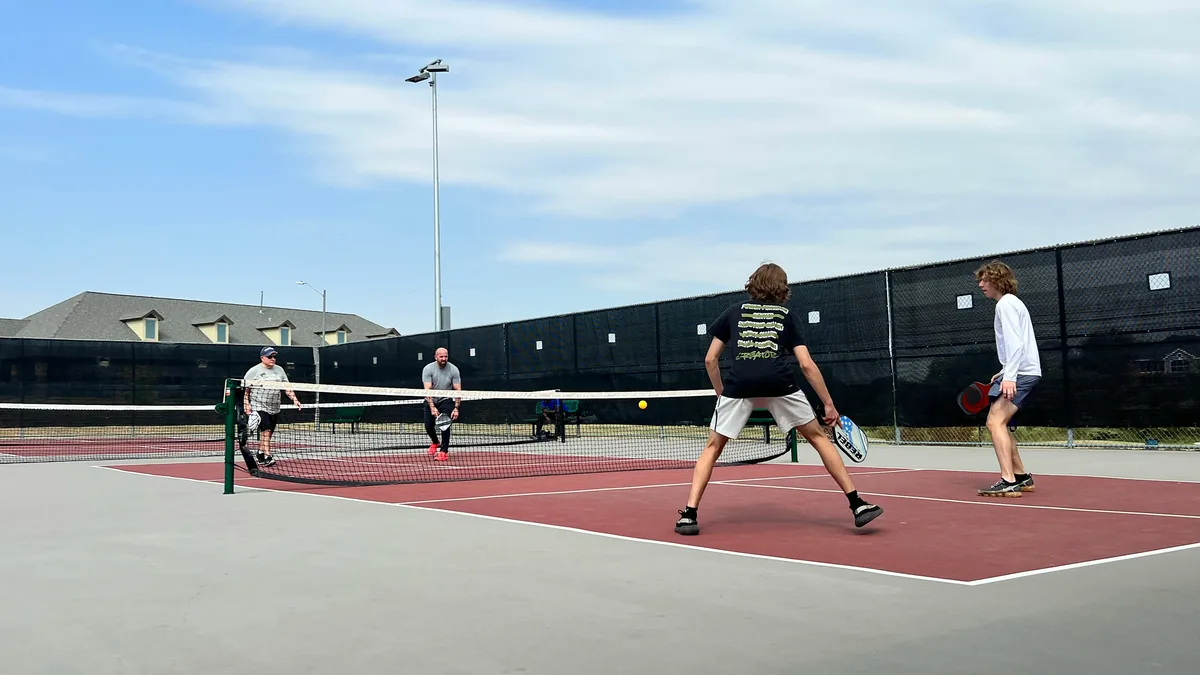
The first wave of the pickleball boom didn’t happen on college campuses. It happened in Sun Belt retirement communities: The Villages in central Florida, Sun City in Arizona, Sun City Texas in Georgetown, communities up and down the Carolinas. The 60-plus demographic adopted pickleball years before everyone else caught on.
Why? It’s a mechanical answer more than a cultural one.
A court that doesn’t ask too much
A regulation pickleball court is 20 feet by 44 feet. A tennis court is 36 by 78. That difference is everything for older bodies.
On a pickleball court, the maximum sprint is about 25 feet from baseline to net. On a tennis court, you might cover 60 feet chasing a wide ball. Multiply that by dozens of points per game, and the load on knees, hips, and ankles is roughly four times higher on a tennis court.
This is why pickleball is sometimes called “the sport for tennis bodies that can’t play tennis anymore.” Many of the strongest senior pickleball players are former tennis players whose racquet skills transferred but whose joints couldn’t keep up with the larger court.
A ball that gives you time
The pickleball is a perforated plastic ball that travels at maybe 25 mph at amateur speeds, with a high drag coefficient that slows it further. A tennis ball, by comparison, can come off a club player’s serve at 60 to 80 mph.
That extra reaction time is the difference between a sport you can play at 65 and one you can’t. Many former tennis players say their tennis reflexes still work fine for pickleball even as they slow down in their 60s and 70s.
A serve you don’t have to wreck your shoulder on
Pickleball requires an underhand serve. The paddle must contact the ball below the waist, on an upward arc. There’s no overhand smash, no ballistic shoulder rotation, no chronic risk of rotator cuff inflammation.
Tennis serves, by contrast, are responsible for a significant share of long-term tennis-player shoulder problems. Pickleball entirely sidesteps that issue.
Doubles by default
Most pickleball is doubles. That cuts the court each player covers in half, again. Two players cover 880 square feet between them; in tennis doubles, two players cover 2,800 square feet between them.
Doubles also makes the sport social. You’re chatting between points, mixing with new people at every open-play session, traveling to tournaments with a partner. The social glue is part of why pickleball spread through retirement communities so fast. Once one resident started playing, three others would learn within a month.
The Sun Belt geography
Pickleball’s first growth was concentrated in places with year-round outdoor weather and a large 55-plus population: Florida, Arizona, Nevada, southern Texas, the Carolinas, southern California. These are also the states with the densest retirement-community infrastructure: planned communities of 20,000 to 50,000 residents, with built-in amenity centers that could put down pickleball courts on demand.
The Villages, FL alone has more than 200 pickleball courts spread across its master-planned community. Sun City, AZ has 50-plus. These weren’t built incrementally; they were built fast, in response to obvious resident demand.
By the time the broader U.S. caught on to pickleball around 2020, retirement-community pickleball was already a decade into its boom.
What changed in 2020+
The pandemic was the inflection point that took pickleball beyond the 55-plus crowd. Outdoor, socially-distanced activity was suddenly the only acceptable form of group recreation. Younger players who’d dismissed pickleball as “a sport for old people” picked up paddles for the first time and discovered the actual gameplay was fast, athletic, and competitive at high levels.
But the senior wave never stopped. It just got joined by a younger wave.
Health upside specifically for seniors
The medical literature on pickleball for older adults is generally positive. Studies have shown cardiovascular benefit, improved balance (which reduces fall risk), and significant mental-health gains from the social component.
The American Heart Association has called out pickleball specifically as a recommended cardiovascular activity for seniors, partly because the intensity scales naturally with skill level: beginners get a brisk-walk-equivalent workout, while experienced players get more intense intervals.
Joint impact is moderate but lower than tennis. Knee specialists generally consider pickleball safe for players with mild to moderate osteoarthritis, especially on cushioned acrylic court surfaces. See our reference on pickleball court surfaces for the surface comparison.
What this means for everyone else
The senior pickleball wave is a useful preview of where the rest of the sport is going. The infrastructure (dedicated courts), the equipment (better paddles, quieter balls for residential settings), and the etiquette (rotation systems for open play) were all developed by and for senior players. The rest of the country is now using that infrastructure too.
If you want to find a serious local pickleball scene fastest, look at where senior players gather. They’ve been doing this longer than anyone else, and they’ve already figured out where the good courts are.