If you’ve spent any time on athletic-club marketing in the last two years, you’ve heard the terms together: pickleball and padel. Both involve paddles. Both are growing fast. Both are pitched as the future of racquet sports.
They are not the same game. They’re not even close to the same game. Here’s the actual comparison.
The court
Pickleball court: 20 feet wide, 44 feet long. No walls. Open air.
Padel court: 33 feet wide, 66 feet long, fully enclosed by glass walls (back walls, side walls). Played indoors or outdoors but always inside a transparent box.
The glass walls are the single biggest design difference. In padel, balls bouncing off the back wall stay in play and are returnable, like in squash. Padel rewards anticipation and angles. Pickleball is purely open-court geometry.
Padel courts also cost much more to build. A regulation padel court runs $50,000 to $200,000 installed, depending on glass quality and surface. A pickleball court overlay on existing tennis surface runs about $1,000. New dedicated pickleball construction runs $20,000 to $50,000 per court.
This cost difference matters for adoption. Padel needs club investment. Pickleball can grow through parks-and-rec budgets and DIY conversions.
The ball
Pickleball: perforated plastic, 0.9 ounces, slow.
Padel ball: rubber, similar to a depressurized tennis ball, faster than pickleball but slower than a regulation tennis ball.
The padel ball bounces more naturally off all surfaces (court and walls) because it’s a rubber-and-felt construction like a tennis ball. The pickleball doesn’t behave well off walls, which is part of why pickleball doesn’t have them.
The paddle
Both use solid paddles (no strings). But:
Pickleball paddle: thin, light, similar shape to an oversized ping-pong paddle, usually composite or graphite face.
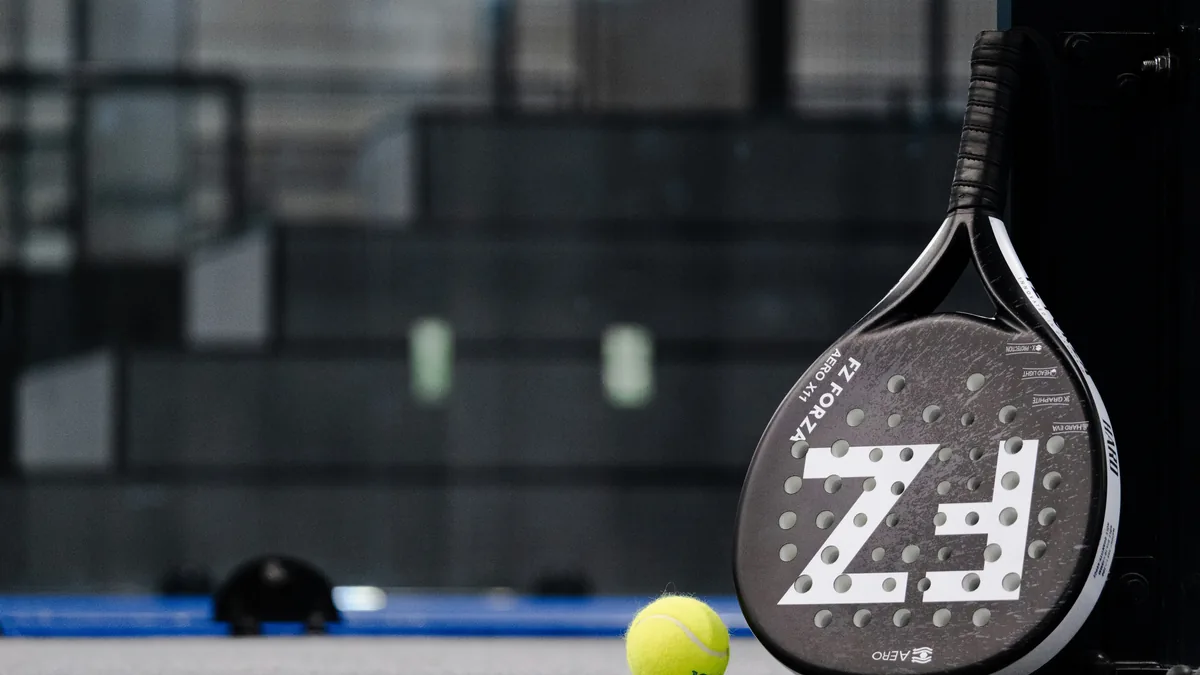
Padel paddle: thicker, slightly heavier, perforated face, designed to add power with less swing. The thicker construction works because padel needs to redirect a faster ball with more force.
How a game is played
Pickleball: Serve underhand from behind the baseline, the ball must bounce once on each side after the serve before either player can volley (this is called the “double bounce rule”), there’s a non-volley zone (the kitchen) 7 feet from the net where you can’t hit volleys, points are won in rallies of finesse and placement.
Padel: Serve underhand bouncing once first, the ball is in play off any wall (yours or your opponent’s), the strategy involves controlling the lob and the wall return, the game has a clear similarity to squash in its anticipatory geometry. Padel is almost always played as doubles.
Where each sport is dominant
Padel is enormous in Spain, Argentina, Sweden, and increasingly the UK and Middle East. Padel passed tennis in Spanish participation a decade ago. Argentine padel is a serious professional tour. The sport’s global capital is essentially Spain.
Pickleball is dominant in the U.S. and Canada, with growing footprints in Mexico and Australia. The U.S. has by far the largest pickleball ecosystem (36 million players, 7,780+ facilities) of any country.
The two sports are growing in different geographies, which is why pickleball clubs and padel clubs are sometimes pitched together: they don’t compete for the same player base in any given country.
Which is harder to learn?
Padel has a steeper learning curve than pickleball. The wall-ball strategy takes time to learn, and reading the angles requires the kind of court awareness that develops through dozens of hours of play. Most padel beginners describe an “aha moment” around session 5 or 6 when the wall returns start clicking.
Pickleball is famously fast to learn. Most beginners can hold their own in a real game by their second session. The skill ceiling is high but the floor is very low.
Padel’s middle ground is harder, too. The gap between “I can play” and “I can win against a competent partner” is wider in padel than in pickleball.
Which is harder physically?
Padel involves more sprinting (the court is larger), more lunging (defending wall returns), and faster reaction times (the rubber ball travels faster). Padel is meaningfully harder on knees and ankles than pickleball.
Pickleball’s smaller court and slower ball make it the more body-friendly sport. This is part of why pickleball blew up with older adults and why padel is more popular with the 25-45 demographic in Spain and Argentina.
Equipment and entry cost
Pickleball: $60-80 paddle, $15 balls, most courts free. Total to start: about $100.
Padel: $80-150 paddle, $15 balls, court rental $20-40/hour at private clubs (almost no free public padel courts in the U.S.). Total to start: $300-500 in the first year.
Padel is fundamentally a club sport in most countries. There are very few free public padel courts; you join a club or pay drop-in fees. Pickleball, by contrast, has thousands of free public courts in the U.S. parks system.
Which one will win in the U.S.?
Both will grow. They’re not really competing.
Pickleball will continue to dominate the U.S. mass market because of its low cost, easy learning curve, and existing infrastructure (every converted tennis court is a free pickleball facility).
Padel will continue to grow as a premium club sport in the U.S., centered in metros with strong international populations (NYC, Miami, LA, Houston) and with high-end fitness clubs. Padel will likely never reach pickleball’s scale in the U.S., but it doesn’t have to. It’s a higher-revenue-per-player business.
If you can only try one and you live in the U.S., try pickleball first. The barrier to entry is lower and the courts are everywhere. If you’ve played pickleball and want a longer-skill-ceiling racquet sport that’s not tennis, padel is the natural step up.