If you’ve never played either, the marketing answer is “try both.” That’s correct but useless. Here’s the answer that actually helps you choose.
The court
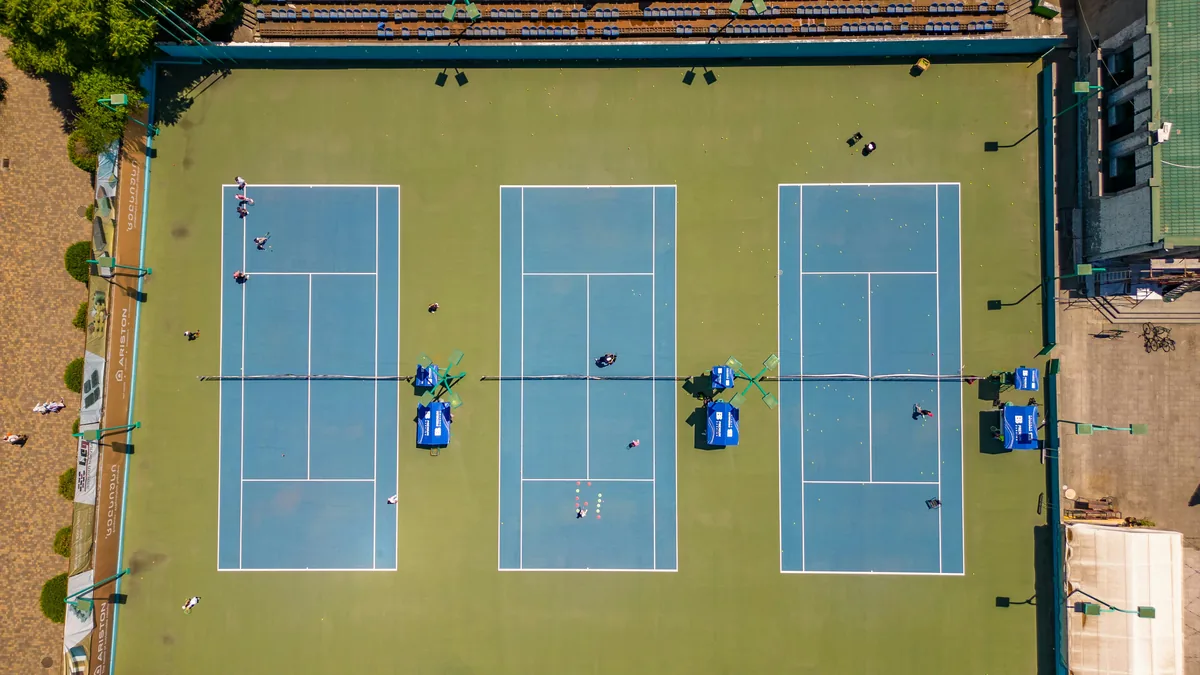
A tennis court is 78 feet long and 36 feet wide. A pickleball court is 44 feet long and 20 feet wide.
Pickleball gives you 880 square feet of total playing area. Tennis gives you 2,808 square feet for doubles, 2,106 for singles. Tennis players cover roughly 3 to 4 times the ground per match.
If you played tennis competitively at 25 and your knees are telling you to stop at 55, that ratio is why. Pickleball can stay in your life much longer than tennis.
The ball
A tennis ball is felt-covered rubber, about 2.6 ounces, traveling at 50 to 120 mph for competent play.
A pickleball is perforated plastic, about 0.9 ounces, traveling at 15 to 40 mph for competent play.
The slower ball is the single biggest reason pickleball is easier to start playing. New tennis players spend months just learning to make consistent contact. New pickleball players make contact on their first day.
The serve
Tennis: overhand, ballistic, can be developed into a 100-mph weapon at amateur levels.
Pickleball: underhand, contact below the waist, on an upward arc.
The pickleball serve is intentionally designed to be a neutral starting point, not a weapon. You don’t win pickleball points on your serve the way tennis players do. The rally is where the game is decided.
This has two consequences. First, the underhand serve makes pickleball much easier on shoulders. Second, the game rewards finesse and positioning over raw power, which keeps competitive pickleball interesting at older ages.
The learning curve
This is where the two sports really diverge.
Tennis has a long learning ramp. Most adult beginners need 6 to 12 months of regular play before they can sustain a real rally with a competent partner. Many quit before that point.
Pickleball has a short learning ramp. Most adult beginners can rally and play a real game by their second or third session. The skill ceiling is just as high (pro pickleball is genuinely difficult to play well), but the entry-level competence threshold is lower by a factor of probably 10.
If you want a sport you can play now, pickleball wins. If you want a sport you’ll spend years improving at, both work, but tennis has a longer skill horizon and more clearly-defined improvement milestones.
The body
Tennis: high-impact, lots of sprinting, hard on knees and shoulders, can punish your back. Tennis elbow is named after this sport for a reason.
Pickleball: lower-impact, shorter sprints, easier on shoulders (no overhand serve), still some risk to ankles and Achilles tendons from rapid direction changes.
For a body in good shape, both are fine. For a body that’s seen 50+ winters or has any joint history, pickleball is more sustainable.
The social structure
Tennis is most often played as singles or scheduled doubles, where you arrange a match in advance with specific people. The social mode is more like booking a chess game than dropping into a community.
Pickleball is most often played as open-play doubles, where you show up to a court, sign up for a rotation, and play games of about 11 points with whoever you draw. Within an hour you’ve played with 8 to 12 different people.
If you’re new to a town and want to plug into a community fast, pickleball does that better than almost any other sport. If you’d rather play with the same partner consistently, tennis fits that mode better.
The cost
Tennis startup: $150 racket (entry level) + $30 stringing + $50 court fees per month if not free + $25 shoes + balls. Roughly $300 to start, $50 to $100/month ongoing.
Pickleball startup: $60 paddle (entry level) + $15 balls + most courts are free + shoes you already own. Roughly $100 to start, $0 to $30/month ongoing.
The cost gap closes if you join a private pickleball club for indoor year-round play, but the baseline cost difference is real.
When tennis wins
Tennis is genuinely better than pickleball if you:
- Are young, fit, and want a long skill development arc
- Prefer playing the same partner consistently
- Want a sport that’s been globally established for 150 years with a deep professional tour
- Want to develop a serving game and high-pace baseline rallies
When pickleball wins
Pickleball is better if you:
- Are over 40 and want a racquet sport that won’t hurt
- Want to be playing real games by week two, not month six
- Want a built-in social community wherever you live
- Want to spend $100, not $300, to find out if you like it
- Travel and want a sport you can find courts for anywhere in the U.S.
The honest answer
Most people who try both keep both. Tennis players who add pickleball often play pickleball when their joints are tired or when they want quick social rec play. Pickleball players who try tennis often find it humbling at first but appreciate the deeper skill development.
If you have to pick one, pick by your situation today, not by what felt right 20 years ago. The right racquet sport for you is the one you’ll actually play three times a week. For most American adults in 2026, that’s pickleball. The numbers back it up: pickleball passed tennis in U.S. participation around 2024 and the gap keeps widening.